

How to Secure Multi-Cloud Environments in Minutes with Automated Firewalls
 Jeff Loughridge, CTO
Modern enterprises rarely choose a single cloud. They inherit AWS, Azure, GCP, plus on‑prem and legacy environments, each with different networking models and security primitives. The biggest challenge is not complexity—it is consistency.
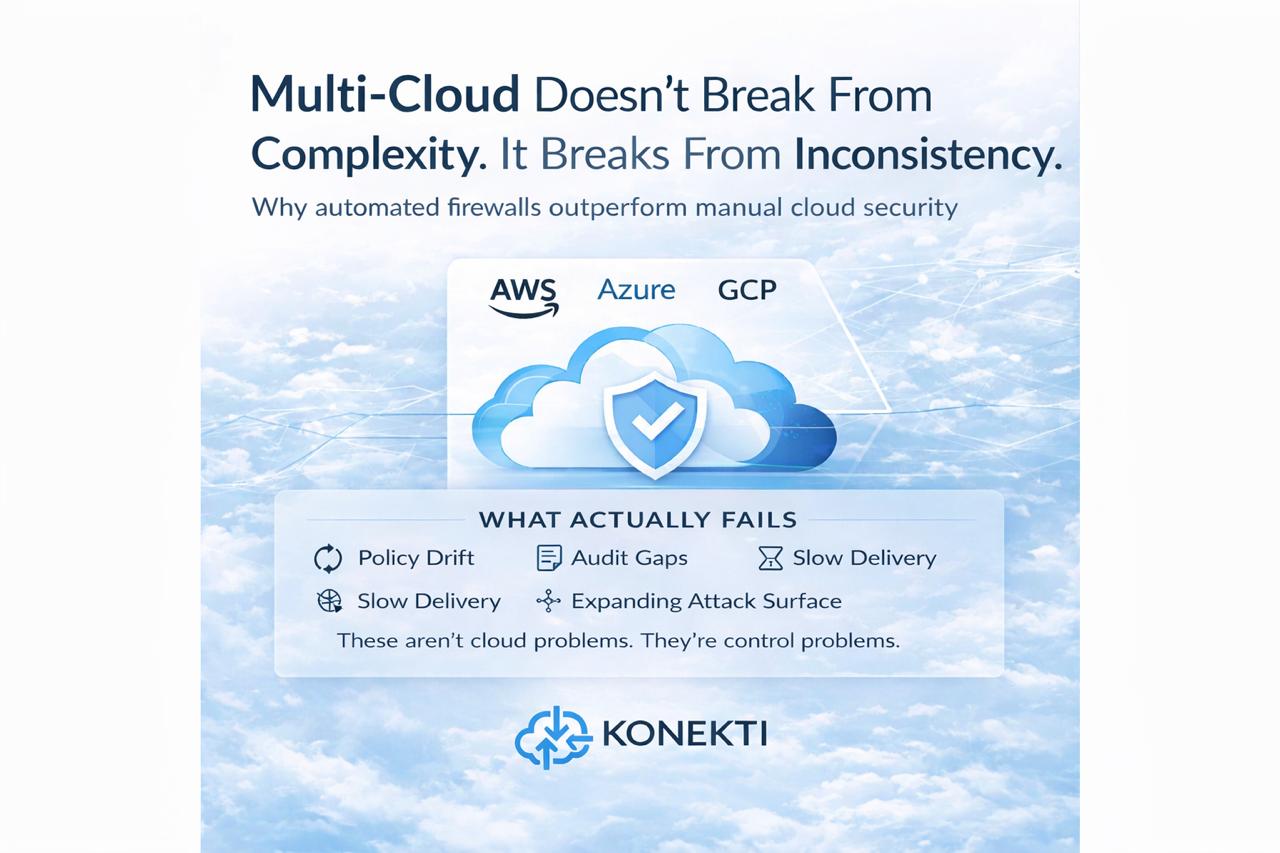
Multi-cloud security breaks when firewall rules, network policies, and access controls are implemented manually, inconsistently, or cloud by cloud. The result is predictable: drift, audit gaps, slow delivery, and a growing attack surface.
Konekti approaches this differently: treat firewalls as code, automate them with Terraform, and enforce one security intent across all clouds, deployable in minutes instead of months.
The core multi-cloud firewall problem
Each cloud has its own firewall constructs:
-
AWS: Security Groups, NACLs, AWS Network Firewalls
-
Azure: NSGs, Azure Firewall, route tables
-
GCP: VPC firewall rules
On paper they “do the same thing,” but they behave differently, are managed differently, and drift differently.
Most organizations respond by:
-
Splitting ownership across separate cloud teams
-
Copy‑pasting rules between environments
-
Relying on documentation that is outdated as soon as it is written
This leads to three systemic failures:
-
Inconsistent security posture
The same application ends up with different ingress and egress rules depending on the cloud it runs in—often unintentionally. -
Audit and compliance gaps
Manual changes make it hard to prove who changed what, why it changed, and whether it aligns with frameworks like HIPAA, PCI, NIST, or ISO 27001. -
Slow delivery
New environments take weeks because firewall updates require manual configuration, review, and approval.
The problem is not multi‑cloud itself; manual security does not scale across clouds.
Cloud-native tooling has not made firewalls obsolete. For regulated industries, cloud firewalls remain a critical security layer. They provide:
-
Explicit network boundaries
-
Egress control (often mandated by compliance)
-
Zero-trust segmentation
-
Centralized inspection and logging
For healthcare, financial services, energy, and government, firewalls are often non‑negotiable as a primary enforcement mechanism for compliance controls. The real question is not whether you need cloud firewalls, but how to manage them without adding risk.
Konekti’s Firewall‑as‑Code approach
Konekti treats firewalls like any other infrastructure component:
If it is not defined in code, it is not controlled.
The approach rests on three principles:
-
Single source of truth
-
Automation over configuration
-
Policy intent over cloud-specific implementation
Terraform becomes the abstraction layer to express security intent once and deploy it everywhere.
How automated multi-cloud firewalls work
1. Define security intent in Terraform
Firewall rules are not configured in cloud consoles. Instead, Terraform modules define:
-
Allowed ingress and egress
-
Network segmentation
-
NAT behavior
-
Logging and inspection policies
This ensures every rule is version‑controlled, every change is reviewable, and every deployment is repeatable.
2. Abstract away cloud differences
Terraform modules encapsulate provider‑specific behavior so the same high‑level policy can map to AWS Security Groups, Azure Firewall policies, or GCP firewall rules. Cloud quirks live inside reusable modules, not in ad‑hoc scripts, enabling consistent enforcement across AWS, Azure, and GCP.
3. Automate deployment via CI/CD
Firewall changes should never be emergency console edits. By integrating Terraform into CI/CD pipelines:
-
Changes are proposed via pull requests
-
Policies are validated before deployment
-
Every change carries a complete audit trail
This eliminates undocumented edits that create drift and compliance risk.
4. Enforce compliance by design
Compliance frameworks require controls, not manual heroics. Codified firewall rules allow you to:
-
Align network policies with HIPAA, PCI, NIST, ISO 27001
-
Enforce egress control and segmentation consistently
-
Prove compliance through code instead of screenshots
Auditors care less about how you clicked through a console and more about whether you can prove enforcement over time. Infrastructure as Code provides that proof.
Why this matters for regulated industries
In sectors like healthcare, financial services, and energy:
-
Egress traffic must be controlled
-
Access must be explicitly defined
-
Changes must be documented and auditable
Manual firewall management makes these requirements fragile and person‑dependent. Automated, multi‑cloud firewalls make them systemic, relying on codified policy instead of institutional memory.
Organizations that adopt automated firewalls see one change immediately: speed.
With Terraform‑based firewall automation:
-
New environments are secured in minutes
-
Policies are reused instead of reinvented
-
Teams stop negotiating one‑off security exceptions
Security shifts from blocker to platform capability.
Konekti specializes in cloud security automation, not generic cloud consulting.
What sets the approach apart:
-
Deep experience with Terraform-based security
-
Firewall‑first architectures for regulated workloads
-
Multi‑cloud designs that avoid cloud‑specific lock‑in
-
Engineering‑driven, documentation‑first delivery
Konekti does more than deploy firewalls; it engineers security systems that scale with your business.
Multi-cloud initiatives usually fail on the security side because control is managed manually, not because the architecture is too complex. Automated firewalls deliver:
-
Predictability
-
Consistency
-
Compliance
-
Speed
-
And, most importantly, control
If your multi-cloud firewall posture cannot be deployed from code, reviewed in Git, and reproduced on demand, it is not secure enough.
Ready to see it in action?
If you want a walkthrough of how Konekti automates multi-cloud firewalls with Terraform—and how this looks in real environments—Konekti can show you. You can arrange a meeting with me using this link.
Contact us to learn more!

Konekti is the partner of choice for organizations looking to secure public cloud workloads. We help businesses elevate their security posture through industry best practices in designing and operating secure cloud infrastructure.
Your email address will not be published. Required fields are marked